The Inner Seasons of Our Mental Health
Why our mental health shifts — and what our bodies can tell us along the way
My mental health used to be something I felt ashamed of, until I began to understand that mental health is simply part of our health.
It isn't fixed, and it isn't as simple as being mentally “well” or “unwell”. It shifts as we move through life, relationships, stress, grief, change, joy and all the very ordinary messiness of being human.
There have been times in my own life when I've felt completely knocked off balance. A client once said to me, “I've been to rock bottom, and it has a basement.” We acknowledged just how awful that place had been for them — and then noticed how different things felt now.
Because our inner world changes.
Just as the seasons move, so do we. There are times when we feel open, energised and connected, and others when we retreat, slow down or simply focus on getting through.
We might even experience several of those inner seasons in the space of a day.
Mental health is a continuum like the four seasons
Mental health is a continuum like the four seasons. We can experience all seasons in one day. Often they are woven throughout a stormy week, or reflected by our inner seasons across the month.
Winter
There is a heaviness to our emotions, and the weight of darker moods can leave us unmotivated and uninspired. We are drawn to retreat and hibernate. With less desire to socialise, perhaps there is a coolness or coldness to how we feel about ourselves and our connection with others. There is a sense of isolation. The benefit of this season can depend on where we are on the continuum.
Spring
This side of ourselves can feel hesitant. The in-between phase. This is where we can feel the pull of the familiar and be drawn back to the comfort of darkness. A gentle emerging happens from a desire to reconnect with ourselves and others more. Spring brings a shift in perspective. There is a sense of hopefulness and a stirring of something new to come. This is a space for renewal, although it’s a delicate place depending on where we are in our lives.
Summer
We feel energised and upbeat, happily engaging with others. Socially open and active, our health and well-being are vibrant. Increased activity encourages further connection and interaction with the world around us. A comfortable confidence within ourselves can inspire positive change. Our capacity to go with life’s ebb and flow improves. We feel more ease and steadiness in our lives.
Autumn
There is a slowing down and a reduced sense of outward energy. Change is in the air, sometimes with a feeling of uncertainty. We begin to retreat, turning inward, pulling away from others towards ourselves and our needs and emotions. Sometimes that turning inward gives us space to notice what we need, what has changed, and what we might need to let go of.”

What is mental health?
Mental health includes our emotional, psychological, and social well-being. It affects how we think, feel, and act. It helps determine how we handle stress, relate to others, and make choices. (Source)
Wherever we find ourselves on the mental health continuum, we must acknowledge this will change as we move through life and different experiences. Whether you are thriving or simply surviving right now, you have mental health, and these are states of well-being that will change as you do.
A personal struggle can cause us to tip towards crisis point and survival mode. With support and compassion, we can move to a state of connection and vibrancy again. Just as someone who is thriving one minute can find themselves struggling the next.
Appreciating this cycle and the ever-changing state of our health and sense of being is so important. If we can learn to acknowledge our experiences and honour our shape-shifting moods and unique needs, we can embrace life’s challenges with kindness. Gradually and hopefully, we begin to break down the walls of stigma and find an openness for the emotional well-being of ourselves and others.
The Mental Health Continuum
Here is a representation of the mental health continuum from Mental Health First Aid England.
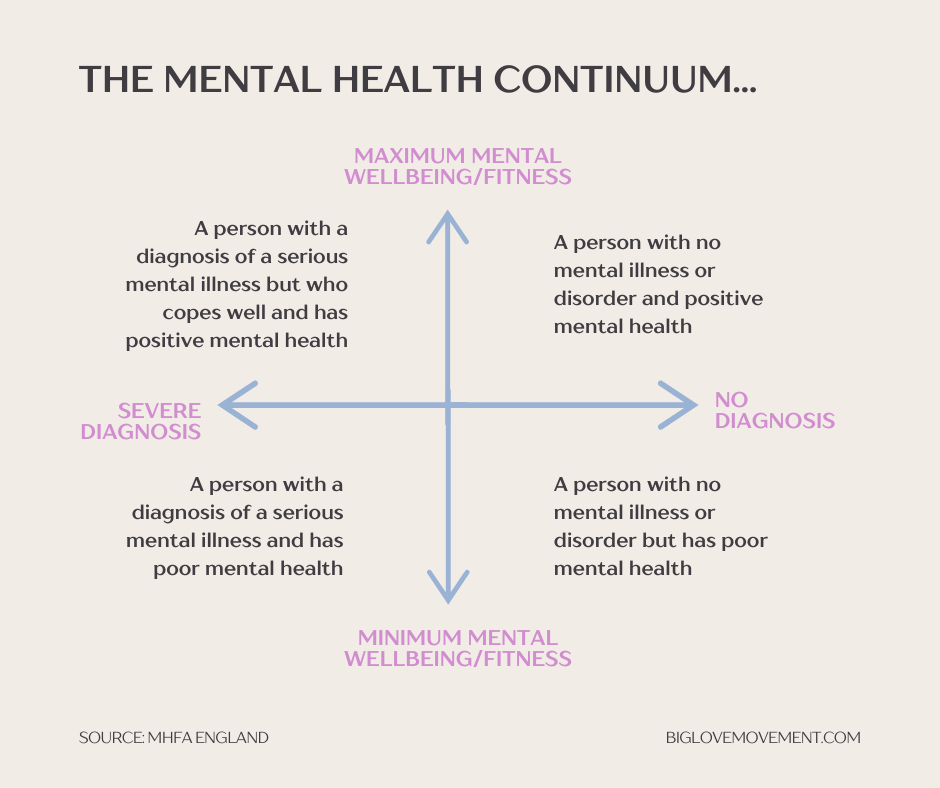
The vertical axis - This axis represents our emotional well-being. The top of the vertical axis is the maximum emotional well-being and the bottom is the minimum.
The horizontal axis represents the medical diagnosis with a severe diagnosis at one end and no diagnosis at the other. This helps us to understand that a person with a diagnosed disorder can have positive mental wellbeing and a person who has no diagnosis can have poor mental wellbeing.
Mental health is fluid and changes over time depending on many different factors, but we all exist somewhere on these axes and can move around them depending on what is happening in our lives or our lived experiences. It is not a case of having or not having illness, or of situations staying the same forever.

Using body-mind awareness as a tool
A stressful experience can knock you off balance, which can be internal or external, and the impact may not be obvious. The tools, inner resources and support systems we put in place help us move out of struggle and away from crisis. We develop and tend to them over time to sustain mind-body wellness. They support us as we ride out the struggles and embrace the wobbles with more ease and self-compassion.
Awareness, empathy, compassion and resources are what we need to help ourselves and each other move through the inevitable challenges we face and rise when we stumble. Our wobbles aren’t simply the ones we see but the ones we feel within our bodies.
Finding compassion for yourself and acknowledging your life experiences is how you become an advocate for yourself and your emotional well-being.
Noticing and using your inner senses
A great tool is learning to recognise your unique signals when your body is in distress, symptoms such as a tightness in your chest, shortness of breath, and tension in your muscles, to relieve the intensity of those symptoms consider giving your body the opposite of those feelings.
Interoception is our conscious awareness of our internal bodily sensations like hunger, emotions, heart rate, and pain. Interoception gives us a general sense of what is going on in our body. It guides how we respond to our environment based on our perception of our bodily states. (Source: Quadt et al., 2018)
Awareness helps to build our inner knowledge and creates a deeper understanding of ourselves. Yoga and mindfulness are supportive practices to develop self-awareness and interoception. Drawing your attention to the present moment enables you to relate wholeheartedly to the world around you, to connect to your innate wholeness, and to play an active and powerful role in your daily health and well-being.
Movement can be a resource
If you’re having a bad day you feel it in your body, like “the weight of the world on your shoulders", or that “gut feeling”. The way you feel emotionally influences your body’s physiology and movement can be medicine. Freeing things up, shifting your physical state to support and improve your mental and emotional well-being.
Slow mindful movements encourage a deeper sense of awareness and help to cultivate confidence, compassion and emotional resilience. Through stretching, breathing, relaxation and movement. Movement and mindfulness can give us another way to meet everyday stress — creating moments to notice, move, breathe and reconnect.
Somatic yoga is designed to help you become more embodied, or reconnected to your body. Being aware of one’s body as you move through space, within poses and sequences, often connected to your breath, and learning to listen to the feedback from the body as you move. In a safe space such as challenging poses focused on strength, stability and balance followed by periods of rest, builds resilience and trains your body to recover from crisis quicker.
Come back to your breath
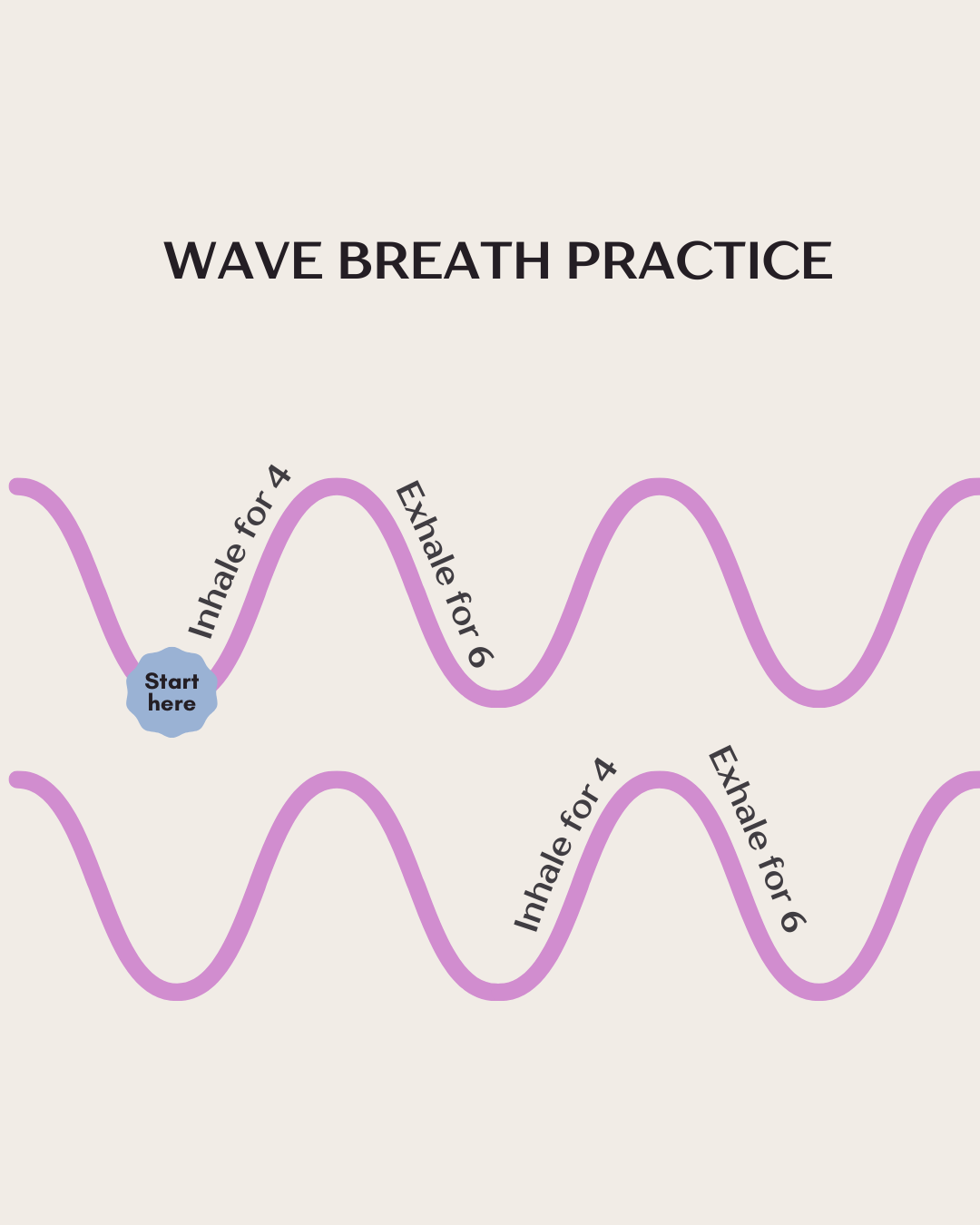
Your breath is one of the simplest resources you can come back to.” “If in doubt, breathe it out.” Think of lengthening your exhalation in the same way as squeezing the brakes on the bike. It’s your body’s inner braking system and taps directly into your body’s rest/digest mode, calming your body down.
Simply becoming aware of your breath pattern can help you better understand your emotions and what your body needs in that moment. When you can’t change your thoughts, change how you are breathing.
Journaling to recognise and reconnect
Using words to describe both physical and emotional feelings in our body helps us to acknowledge and honour how we are feeling. We can also make our emotions more tangible when we write them down or say them out loud, rather than a sea of unhelpful thoughts racing through our minds.
Explore these reflective prompts when life is feeling overwhelming…
What am I feeling right now?
What am I noticing in my body?
What might my body be communicating to me?
What do I need right now — less, more, or something different?
What thoughts are taking up space in my mind?
What feels within my control right now?
What resources or support could I lean on?
What would feel kind or supportive in this moment?
Cultivating self-compassion
The urge to ‘crack on’ and ‘deal with it later’ is an attitude we need to change. There’s power in slowing down and switching gears. Not slowing down only prolongs the symptoms, they take root and the scales begin to tip.
The 4Rs will help you become more aware and cultivate self-compassion.
Recognise - Become aware, noticing with curiosity and compassion.
Respond - acknowledge - What you’re feeling and what you need.
Rebalance/Reconnect - What tools and inner resources can you call on for support?
Reset or Rest - What do you need? How does that look for you today?
Sometimes we have capacity for movement, connection and doing more. Sometimes we need quiet, rest, support or simply fewer demands. Learning to notice those shifts — without immediately judging or trying to fix them — can be an important part of looking after our mental health.
At Big Love, much of what we do begins here: helping you understand what is happening in your body, recognise what you might need, and build a collection of practical resources you can come back to in real life.
If you're looking for somewhere to start, explore the Big Love Resource Hub for simple practices around stress, anxiety, rest, sleep and nervous-system support.
And if you'd like ongoing support, The Membership is our home for homebodies — with live practices, replays and resources you can use from home, in your own time and without any pressure to show up a particular way.
Big love,
Becki x